SameGame looks deceptively simple. Click groups of matching blocks, they disappear, the board collapses. But most players hit a ceiling around a few hundred points and wonder why. The answer is almost always the same: they are clearing too many small groups.
Here is how the scoring actually works, and what to do about it.
The scoring formula
Every time you remove a group of blocks, you earn (n - 2)² points, where n is the number of blocks in the group.
That formula does not scale linearly. It scales exponentially.
| Group size | Points |
|---|---|
| 2 | 0 |
| 3 | 1 |
| 5 | 9 |
| 8 | 36 |
| 10 | 64 |
| 15 | 169 |
| 20 | 324 |
A group of 2 is worth nothing. A group of 20 is worth 324 points. Ten groups of 4 give you 40 points total. One group of 20 gives you 324. The math is ruthless.
This means your entire strategy should be about making fewer, bigger moves rather than clicking everything as fast as possible.
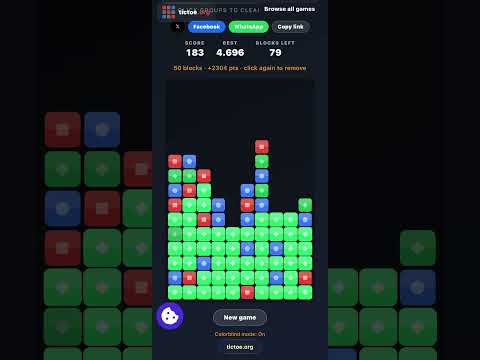
Here is what that looks like in practice — a 51-block group worth 2,401 points on its own, in a run that went on to clear the entire board:
Think before every click
The most important habit in SameGame is pausing before you click. Every move changes the board, and some moves open up large future groups while others permanently strand blocks.
Before you click a group, ask: if I remove this, will it merge two colour pools together or split them apart? A move that looks small now might connect two separated regions of the same colour into one large group on the next turn.
The game shows you the group size and points before you commit. Use that preview. If a group is worth fewer than 9 points (that is, fewer than 5 blocks), it should usually wait unless clearing it unlocks something bigger.
Work from the bottom up
Blocks fall downward when a group is removed. Columns collapse left when they empty out. Understanding this changes how you plan.
Clearing a group near the bottom of a column causes everything above it to drop, which can merge blocks of the same colour that were previously separated. This is usually good. Clearing near the top does nothing to help connectivity below.
As a general rule, start building from the lower rows and work upward. You have more control over where things land, and drops create more merging opportunities.
Never strand single blocks
The most common reason players score badly is leaving isolated single blocks that can no longer be part of any group. Once a block has no neighbours of the same colour, it is stuck. It counts against your final total because you end the game with blocks remaining.
Watch for this pattern: you have a column of red blocks, and on either side are blue and green. If you clear the blue and green columns, those reds become unreachable. They will sit there until the game ends, costing you the board clear bonus.
If you notice a block is about to become isolated, clear it now while it still has a group to join, even if the group is small. A 4-point group is better than a stranded block that blocks your bonus.
The board clear bonus
Clear every single block from the board and you get a 1000-point bonus on top of your regular score.
That bonus changes the whole calculus. Even a modest game where you score 400 or 500 from groups becomes a 1400 or 1500-point run if you clear the board. A full clear is almost always worth more than abandoning one because it seemed unlikely.
This means it is worth taking slightly less efficient moves late in the game if they keep the path to a full clear open. Cleaning up a pair of small groups at the end to empty the board is worth it.
Colour management
With three colours on a 10x15 board, one colour will always be in shorter supply than the others. Track which colour has the fewest blocks. Those are the ones you want to clear last, when the remaining groups are largest.
A useful approach: use the most abundant colour as your starting point. Clear large groups of it early to create space. As the board opens up, the remaining colours have more room to consolidate, and you can start building bigger groups from them.
If you ever find two large same-colour regions separated by a thin strip of another colour, clear that strip first. Merging large regions is the single biggest source of points in the game.
What counts as a good score
To give you something to aim for:
- Under 200: You are clearing a lot of small groups. Try holding off until groups are at least 5 blocks.
- 200 to 600: Solid play. You are thinking ahead but probably leaving some isolated blocks.
- 600 to 1500: Strong. You are likely getting partial board clears or one or two very large groups.
- Over 1500: You are playing efficiently and probably clearing the board regularly.
The current best on the leaderboard is in the 4,000+ range, achieved through a combination of very large groups and a board clear bonus.
The gap between an average run and a great one almost always comes down to patience. The temptation to click a group as soon as you see it is strong. Resist it, look for what that removal unlocks, and save your big moves for when they are as big as they can get.